
You’ve found the person. Now you’d like to ask them something in the most beautiful city you could think of, and you’d like it to go well. We photograph proposals in Paris most weeks of the year, which means we’ve watched a lot of people plan this — the ones who thought of everything, and the ones who forgot the single thing that mattered. Here’s what we’d tell you if you called us today.
Do you want the best tips to plan your Paris proposal, always accessible? Download our free guide ->
1. Decide whether you want an audience
The first real decision, and it has nothing to do with location.
A Public Proposal
Means applause. Strangers clapping, someone filming on their phone, a small crowd of people delighted for two people they’ve never met. At Trocadéro on a summer morning, this is essentially guaranteed, and for some couples it’s the best part of the whole day.
A Private Proposal
Means the moment belongs entirely to you. No audience, no performance, nothing to manage. Quieter, and for many people considerably more moving.
There’s no better option, only the one that suits your partner. The question worth sitting with is: at the happiest moment of their life, would they want to be looked at, or would they want to be left alone? You already know the answer.

2. Choose your time before you choose your spot
This matters more than the location, and almost nobody thinks of it first.
The same bridge at 6.40am and at 11am are two entirely different proposals. At sunrise you’ll have soft light, a handful of people, and no strangers in the background of your photographs. By mid-morning the same spot is full, and you’re proposing in front of an audience whether you chose one or not.
So decide on the audience question first, then pick your hour, then pick your place. In that order.
During June, sunrise is just before 6 am. In December it’s closer to 8.30 am — one of several reasons a winter proposal is easier to plan than people expect. Bare trees, soft light, empty landmarks and a civilised alarm.
If you’d like a crowd, aim for mid-morning at Trocadéro or the Champ de Mars. If you’d rather not, set the early alarm. Nobody has ever told us they regretted it.
3. Choose your location
Paris will not run short of beautiful places. The question is which one fits you.
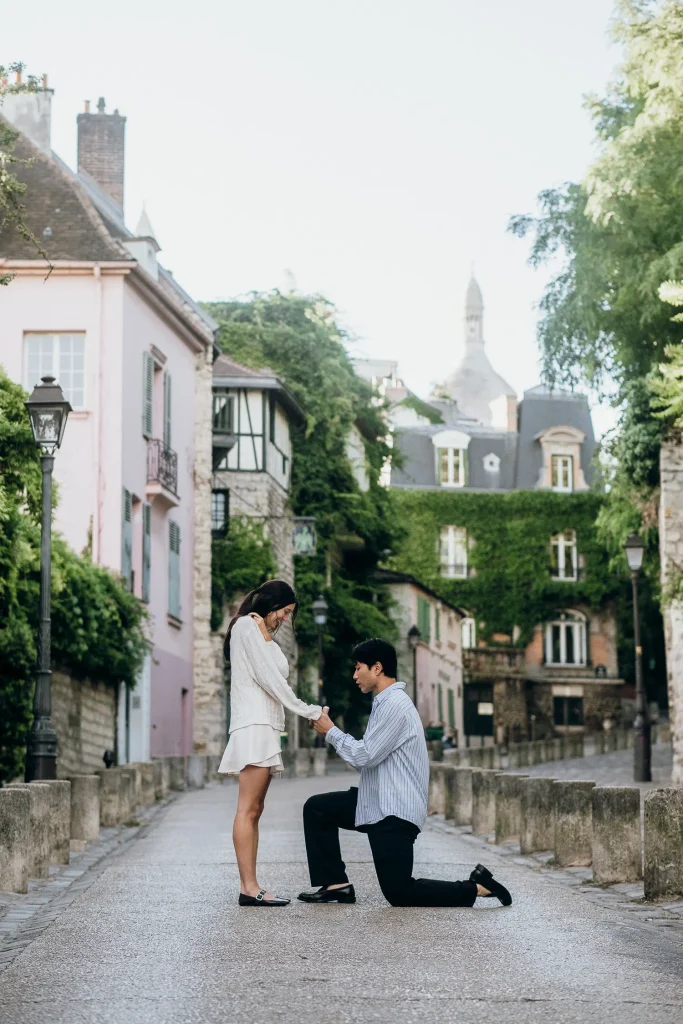
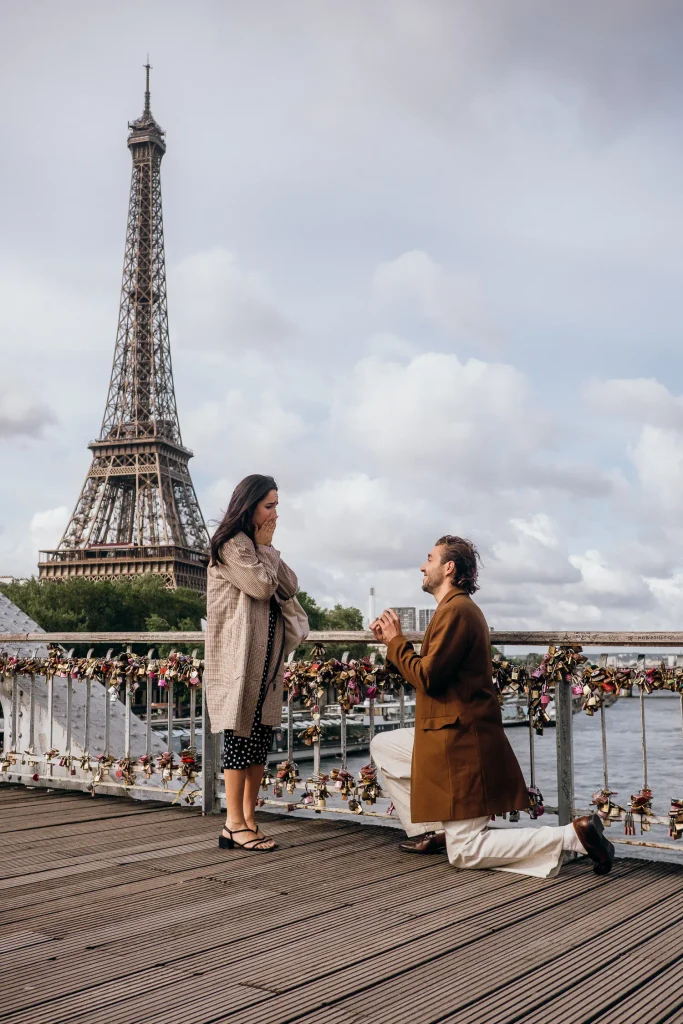
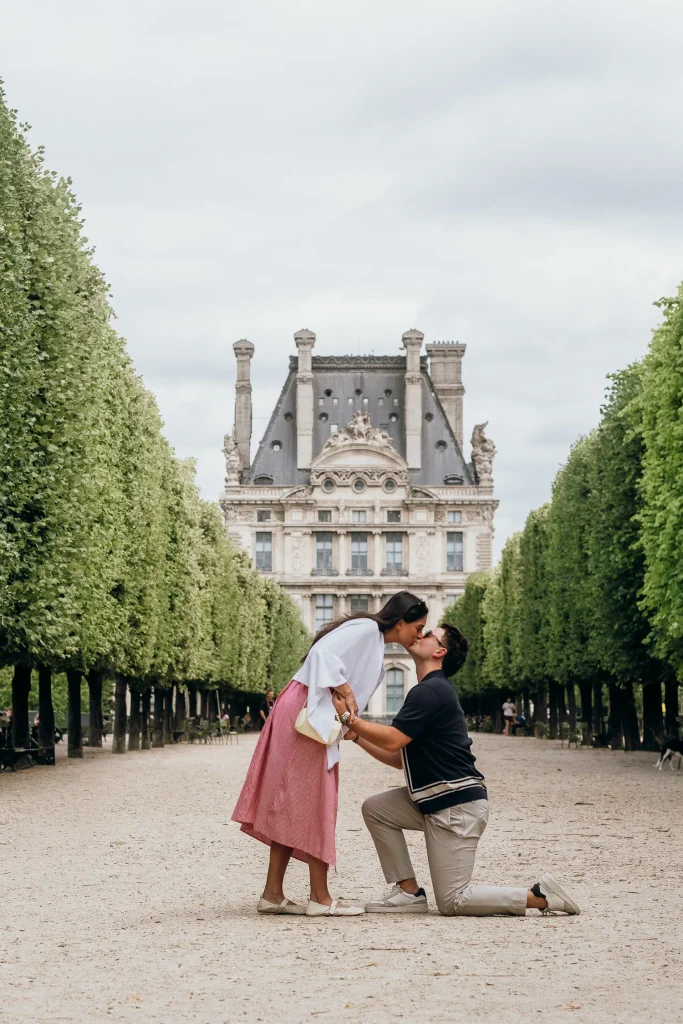
If you want the classic photograph, Pont Alexandre III and Trocadéro are the two great choices — grand, gilded, unmistakable. You’d rather be alone? Place Dauphine, the Seine quays and Parc Monceau are quiet at almost any hour. If you want a story nobody else has, there’s a working vineyard in Montmartre and a botanical glasshouse from 1761 on the western edge of the city.
Whatever you choose, choose a backup at the same time. Paris is unpredictable: a film crew appears, an area closes, a demonstration reroutes your morning. The backup should be a two-minute walk away, and knowing it exists will let you stop worrying about it.
Our full guide to 20 places to propose in Paris, with privacy ratings and timings →
4. Travelling with the ring
The most nerve-racking part of the whole plan, and the part nobody warns you about.
Finding out their ring size without giving it away
- Borrow one: Take a ring they already wear on the right finger for a day, and trace the inside circle onto paper.
- Use a cover story: You’re shopping for your mother, your sister, a friend. Could you borrow their hand for a second, just for reference?
- Ask a friend: Their closest friend very often knows, and is usually delighted to be asked.
If you get it wrong, it’s fixable. Almost every jeweller resizes. Don’t let this be the thing that stops you.
Getting the ring through the airport
- Keep it in a soft-lined box — the one it came in is ideal.
- Add a discreet note. Something like “Engagement ring inside, please be discreet” is usually enough for security to protect the surprise if they open your bag.
- Carry it yourself, in hand luggage, in a pocket of your bag your partner has no reason to open. Never in shared luggage, and never checked.
- Don’t give them a reason to search you. Liquids the right size, laptop out, nothing that will trigger a second look.
- Have a distraction ready. If your bag does get opened, send your partner for coffee. You’ll need to think quickly, but this is a solvable problem.
Once you’ve arrived
- Use the hotel safe, not a suitcase pocket.
- Move it before you get dressed, not while your partner is in the room.
- Check your pockets in the morning. A ring box makes an obvious rectangle in a fitted jacket. A coat pocket is safer — we’ve watched a jacket pocket give the game away more than once.


5. Decide how much help you want
Some proposals need nothing more than a good location and a clear head. Others — flowers, a musician, a specific table, a rooftop — need someone coordinating.
We handle the photography, and we plan the rest of the morning with you: the location, the timing, the exact meeting point, the backup if the weather turns. Every client gets our WhatsApp and email in the months beforehand, and people use it for everything from restaurant recommendations to which métro line runs at 6 am.
If you want elaborate staging beyond that, the best would be to contact a proposal planner.


6. Think about what you’ll say
Not a speech. Just enough that you’re not standing there searching for words while your hands shake.
Most people find it helps to know how they’ll start — the first sentence, the thing that signals this is not an ordinary moment. After that, it tends to look after itself.
Worth thinking about: when you knew. What your life looks like with them in it. Why here, why now. And then the question, which is only four words and has never needed embellishing.
You don’t need to memorise anything. Nobody has ever been marked down for getting emotional.
7. Choose your cover story
The proposal itself is easy. Getting your partner to the right place at the right time, in an outfit they feel good in, without suspicion — that’s the part that takes thought.
The most reliable approach we know is telling them you’ve booked a couples photoshoot. It’s true, it explains the photographer, and it means they’ll have dressed for it.
How a surprise proposal actually works — cover stories, signals, and how we stay invisible →
8. Plan for bad weather
You’ve planned for months, and you wake up to rain. Here’s the honest advice: go ahead anyway.
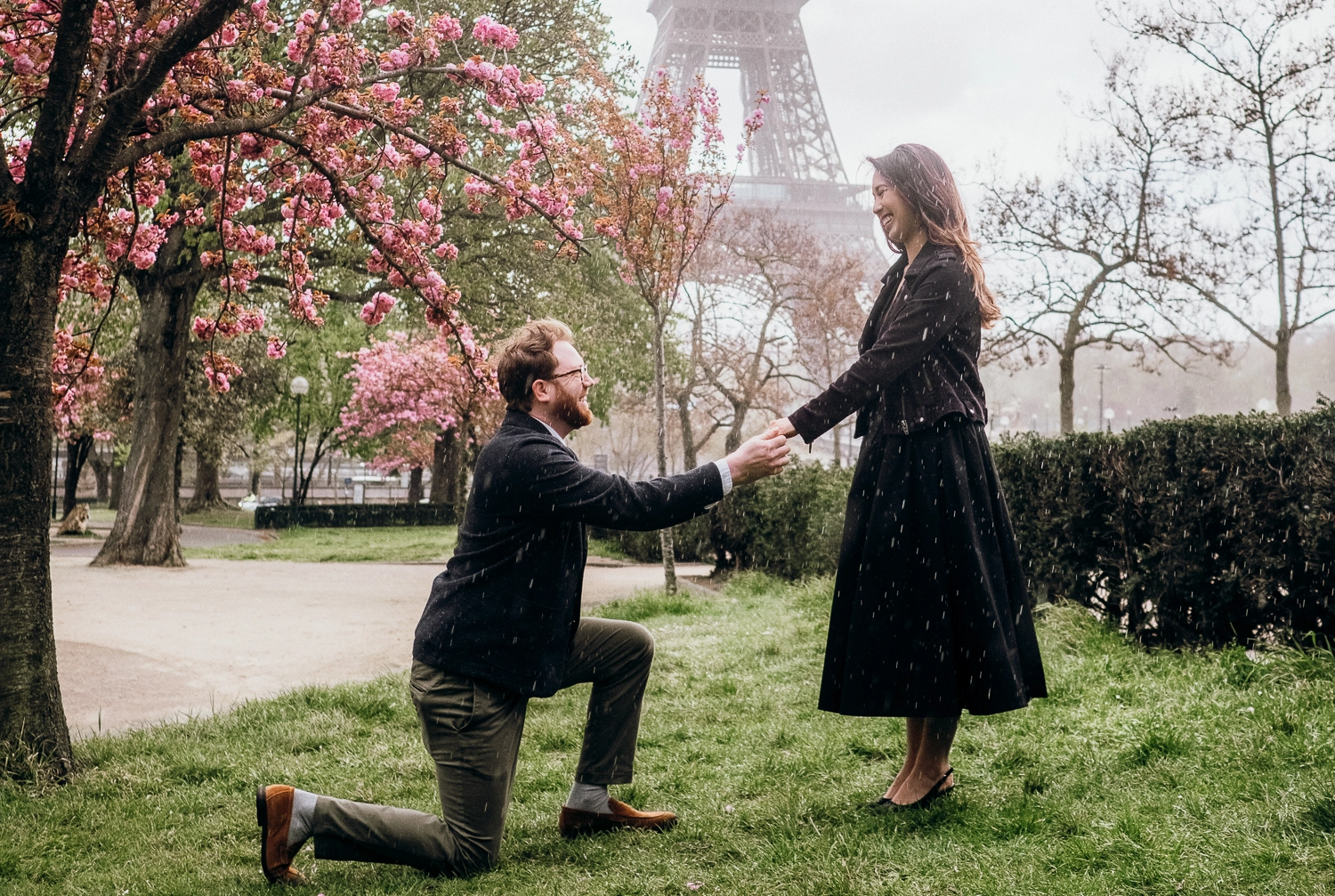
Rain empties Paris. The landmarks you couldn’t have had to yourselves are suddenly quiet. Wet stone reflects every light in the city. And two people under one umbrella is not a compromise — it’s one of the loveliest photographs we take all year.
Paris rain is usually brief. If it’s genuinely heavy, shift by an hour, and it will often have passed. Keep a covered backup in mind — a passage, an arcade, a café terrace — and you’ll be fine either way.
Why we’d rather you didn’t reschedule →
9. Think about the hour afterwards
Almost everyone plans up to the “yes” and not one minute past it, and then finds themselves standing on a bridge at seven in the morning, newly engaged, with nothing arranged.
Worth deciding in advance:
- Who you’re calling first, and whether the time difference allows it
- Whether you’d like breakfast somewhere good — you’ll want to sit down, and neither of you will have eaten
- Whether to tell family that day or keep it to yourselves for a few hours
- Whether you want photographs of the two of you afterwards. These are frequently the ones people love most — nobody has to be told to look happy — and they only exist if you’ve booked the time for them
The proposal is a moment. The morning after it is the part you’ll actually spend together.
10. Book your photographer
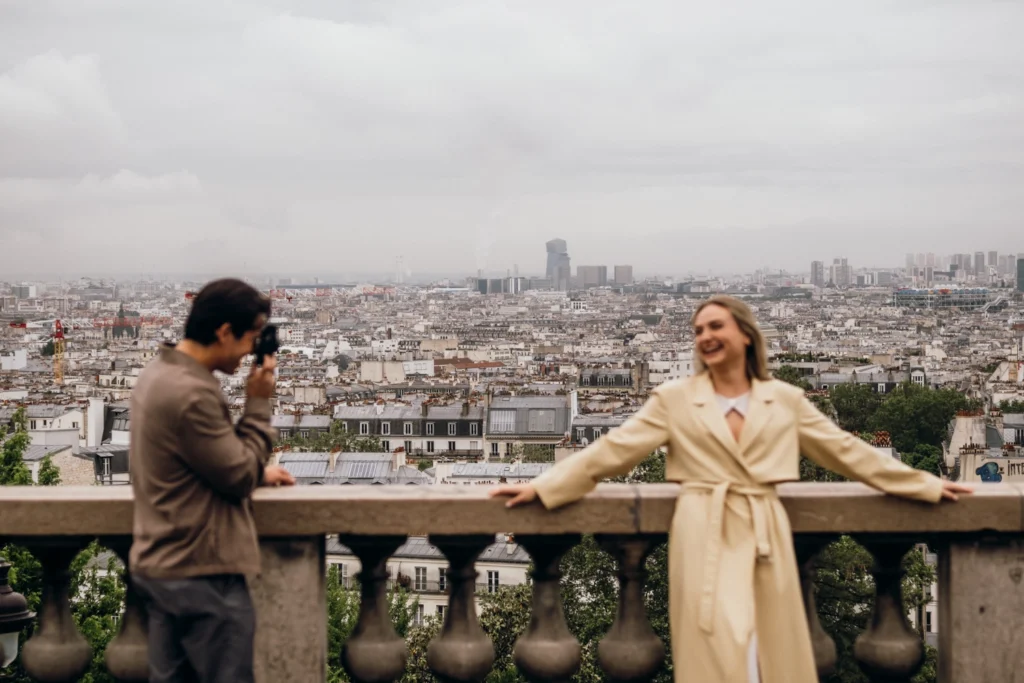
A proposal happens once. However confident you are about the moment, you will not remember it clearly afterwards — almost nobody does. What people remember is the photographs.
We can work two ways. Completely hidden, at a distance with a long lens, so your partner has no idea until it’s over. Or as a couples photoshoot they know about, where you propose partway through and the surprise is the proposal rather than the camera. Both are lovely; they suit different people.
Whichever you choose, we’d suggest booking more time than the proposal itself needs. Thirty minutes captures the moment. An hour or two captures the moment and the first hour of being engaged, which you’ll only ever have once.
[See our prices and session lengths →]
One last thing
You are going to be nervous. Everyone is. We have watched people who negotiate for a living lose the ability to form sentences on a bridge at sunrise.
It goes well anyway. It goes well because the person you’re asking already loves you and has probably been wondering when you’d get around to it.
Frequently asked questions
How do you plan a proposal in Paris?
Decide whether you want an audience, choose your time of day, then choose the location and a nearby backup. Sort out how you’ll travel with the ring, agree a cover story, and plan what happens in the hour afterwards.
What’s the best time of day to propose in Paris?
Sunrise, for almost everyone. Landmarks are nearly empty, the light is soft, and no strangers appear in your photographs. Around 6 am in June, closer to 8.30 am in December.
How do you keep a proposal in Paris a secret?
The most reliable cover story is a couples photoshoot your partner knows about, which explains the photographer and means they’ll dress for it. Keep everything else in character — unusual behaviour gives the game away far more often than a photographer does.
How do you travel with an engagement ring?
In hand luggage, in a soft-lined box, in a pocket your partner has no reason to open. A discreet note asking security to be careful usually protects the surprise if your bag is opened. Never pack it in shared or checked luggage.
Do you need permission to propose in Paris?
No permission is needed in a public space. Restaurants, hotels, and private venues have their own policies, and elaborate setups usually need arranging in advance.
What if it rains on the day of my proposal?
Go ahead. Rain empties the landmarks, wet stone reflects beautifully, and Paris rain is usually brief. Keep a covered backup location in mind and shift by an hour if it’s heavy.
How far in advance should I book a proposal photographer in Paris?
As early as you can for sunrise slots between April and October. We take only two or three sessions a day, so it’s worth asking as soon as you have dates.
When you’re ready
Tell us what you’re planning — where you’re thinking, what your partner is like, whether they’d love a camera or hate one. We’ll tell you honestly what we’d do.
[Start planning your proposal →] · [20 places to propose in Paris] · [Our prices] · [Where we shoot]


