
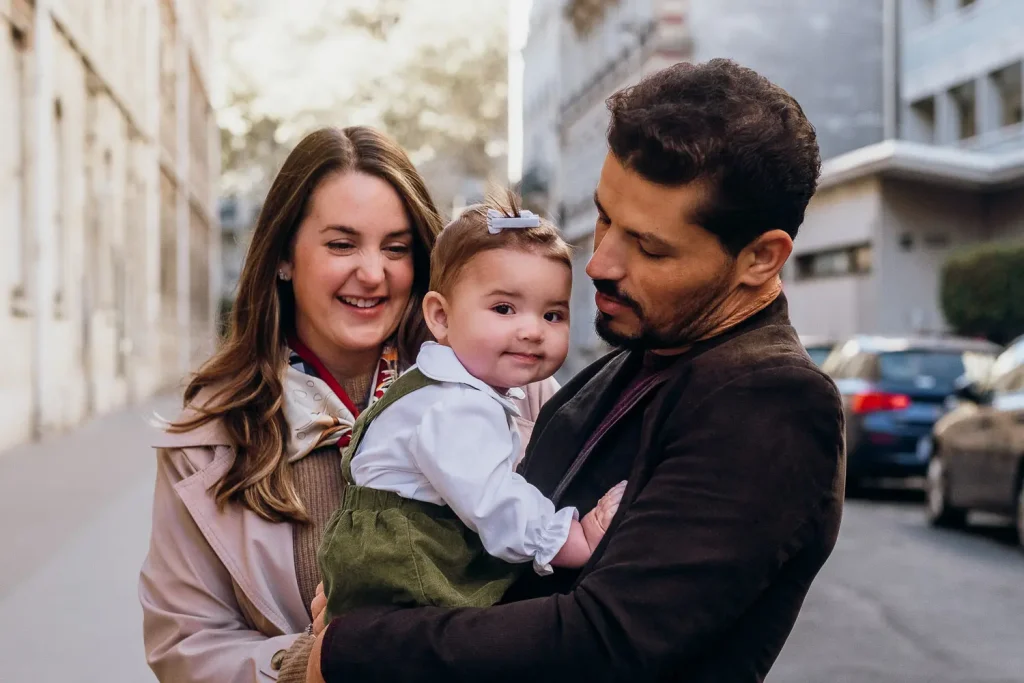
You have four thousand photographs of the baby.
You have about six of all of you together, and in most of them someone is cut off at the shoulder because whoever was holding the phone had one arm free.
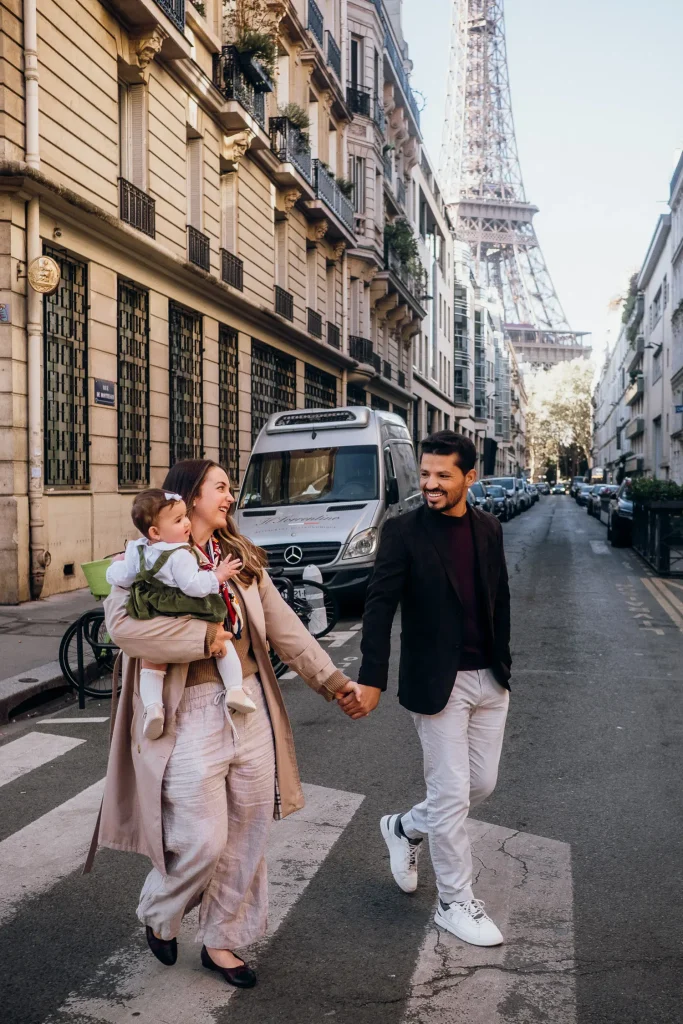
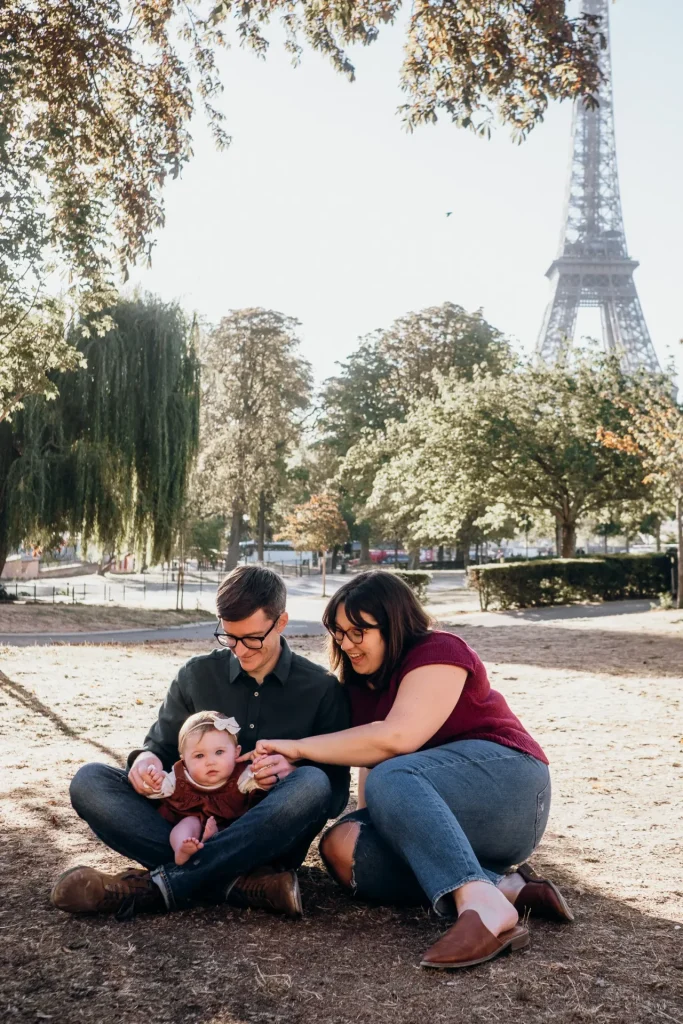
That’s the particular problem of the first couple of years. One parent is always behind the camera, and the result is a complete record of a small person and almost nothing of the family they arrived into. We work as a Paris family photographer team, and this is the gap a session fills — not pictures of the baby, which you already have, but pictures of the three or four of you.
Why people bring babies to Paris
To introduce them. Grandparents who live in Europe, or a family spread across two continents, and a baby who needs meeting. These are among the most moving sessions we photograph — the first time someone holds a grandchild is not a thing you get twice.
Because it’s the first trip. The one where you discover what travelling with a baby is actually like, and survive it, and want proof.
For a first birthday. A trip to mark the year, often with the grandparents who came for the birth.
Because you did a babymoon here. A good number of our maternity clients come back. If you were photographed pregnant on Pont Alexandre III, standing in the same spot holding the baby is a photograph worth having.
Or no particular reason at all. You’re in Paris, and the baby is small, and it won’t be again.
What we do and what we don’t
Worth being clear, because “newborn photography” means something specific to most people.
We don’t do studio newborn sessions. The wrapped-in-a-blanket, posed-in-a-basket, soft-backdrop kind. That’s a real craft, and it isn’t ours — those photographers work indoors with heating, props, and a lot of patience, and if that’s the photograph you want, you want one of them.
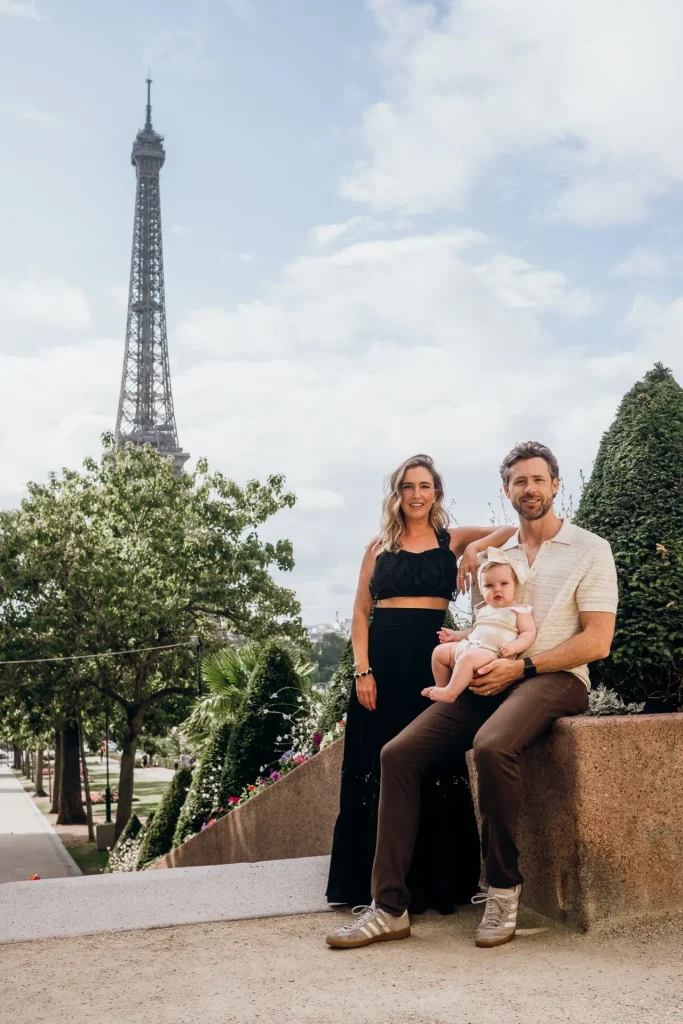
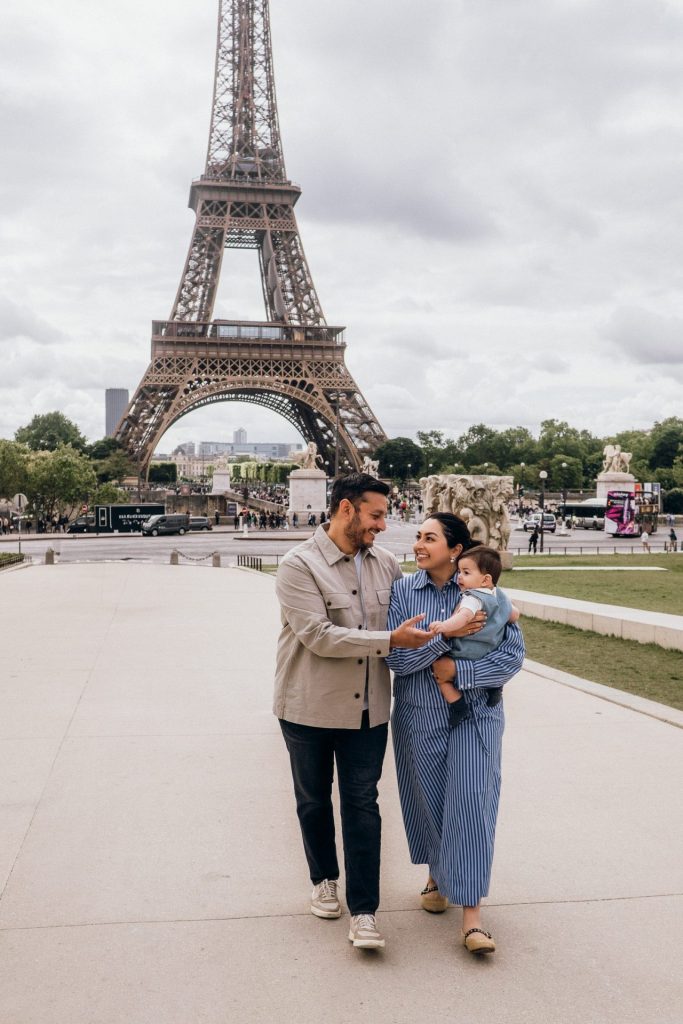
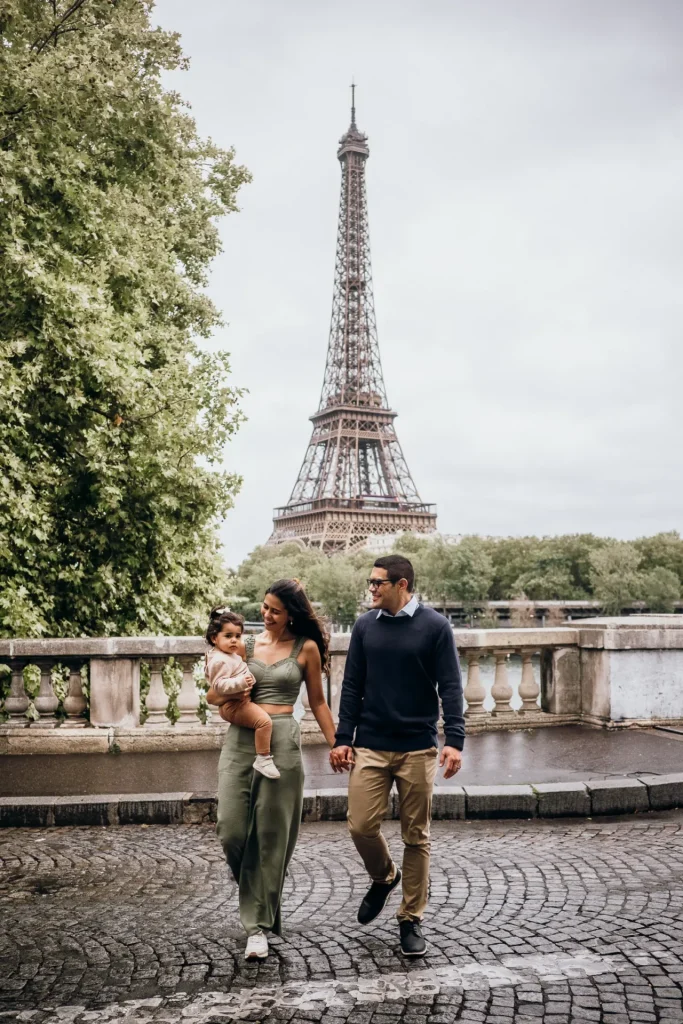
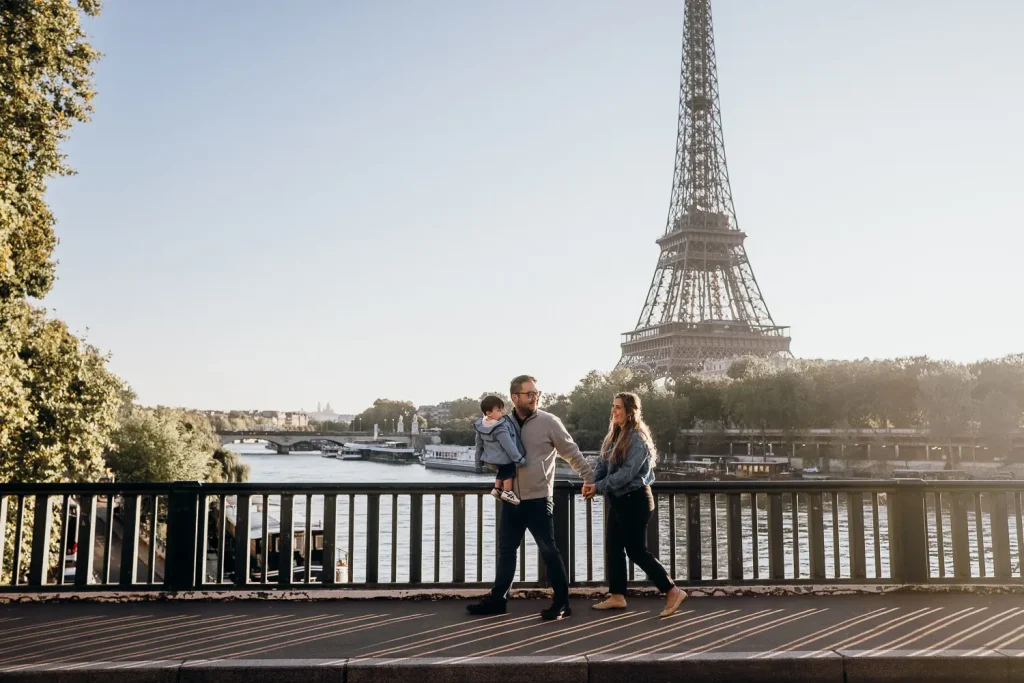
What we do is photograph your family outdoors in Paris, with the baby in it. Held, carried, asleep in a sling, looking around, being kissed on the head. The city behind you and the three of you in the frame.
If you’re in Paris and want photographs of your family rather than portraits of your baby, that’s us.
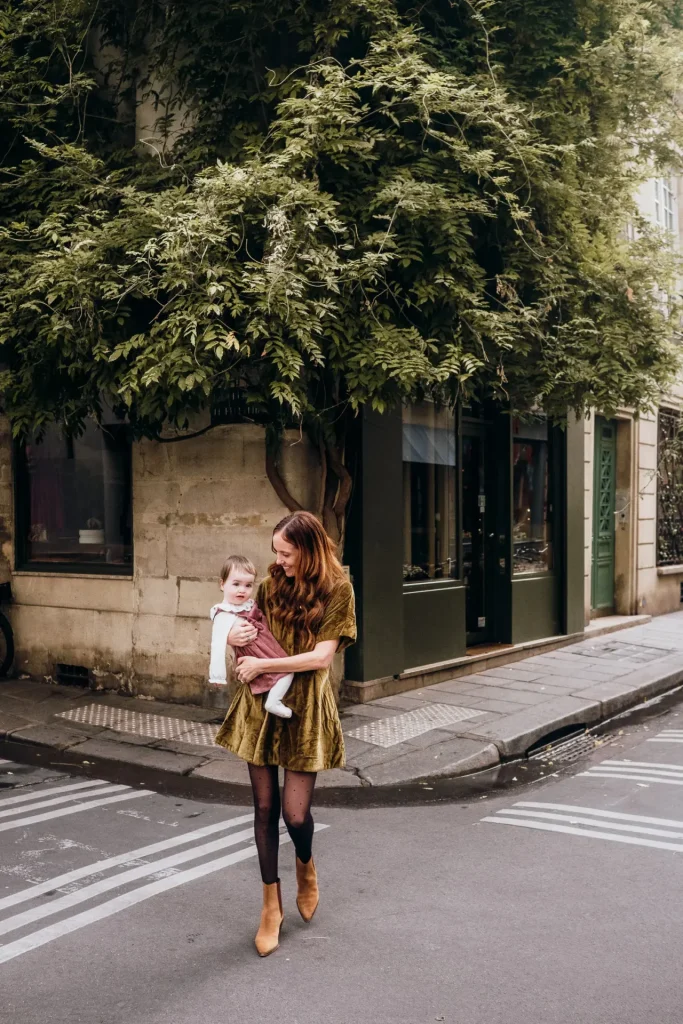
Four ages, four different sessions
A six-week-old and an eighteen-month-old are not the same job, and knowing which you’ve got changes everything about how we plan.
Under three months. The easiest age, genuinely. They sleep through most of it, they’re portable, and they’re happy in a sling or in arms. The photographs are about you holding them. Shorter sessions work well — thirty minutes is often plenty.
Three to eight months. Our favourite window. Awake, interested, not yet mobile. They look at things, they grab faces, they smile at strangers. Sitting up unassisted makes a real difference to what’s possible.
Eight to fourteen months. Crawling or cruising, which means movement. Brilliant energy and harder to contain — we work with it rather than against it, and these sessions need somewhere safe to put them down. Grass, not gravel.
Fourteen months to two years. Walking, opinionated, and fast. Effectively a toddler session, and the advice in our family guide applies more than anything here.
Tell us the age in months when you book. It genuinely changes which location we suggest.
Flying to Paris with a baby
The practical part, and the bit that catches people out.
Your baby needs their own passport. This surprises a lot of first-time parents. They can’t travel on yours; processing takes weeks, and it’s longer in peak season. Start it early.
Check whether you need anything else. Depending on where you’re travelling from and who’s travelling, you may need a birth certificate, proof of age for an infant fare, or — if one parent is travelling alone with the baby — a letter of consent from the other. Rules vary by country and airline, so check yours in writing rather than assuming.
Infants usually fly on a lap under two, but policies, fares and the paperwork differ between carriers. Worth confirming when you book rather than at the gate.
Feed on takeoff and landing if you can. The pressure change is the main thing babies object to, and sucking helps.
Take the pram to the gate. Most airlines let you, and it’s the difference between a manageable airport and a miserable one.
Pack double what you think. One spare outfit is one too few, and this applies to the photoshoot as much as the flight.
We’re photographers, not a travel advisory — your airline and your country’s passport office are the people to confirm all of this with.
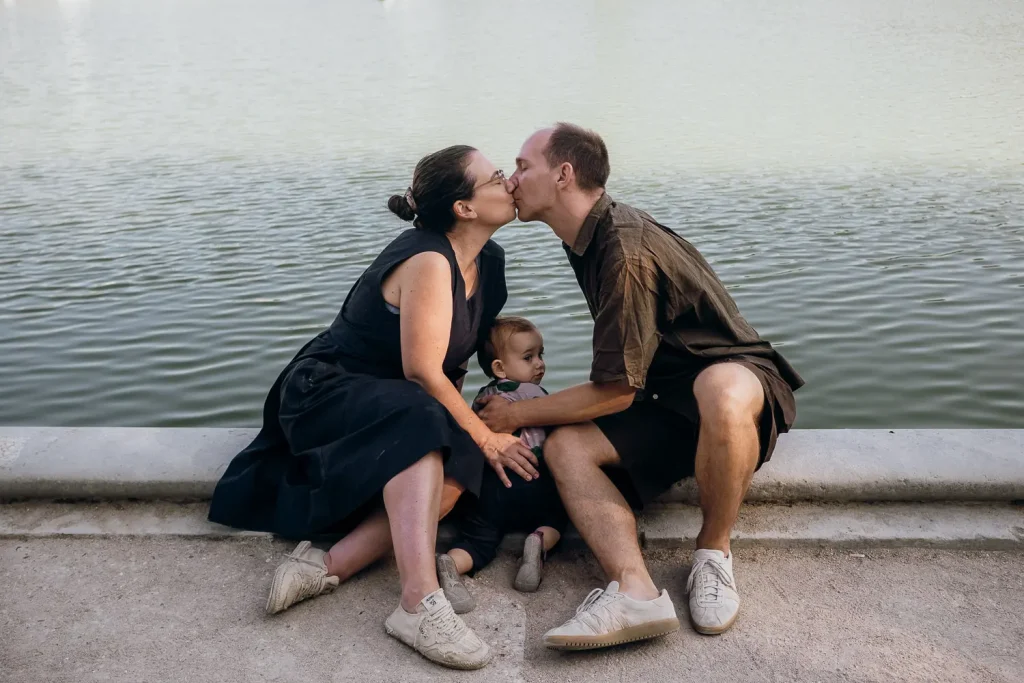
Prams, cobblestones, and which locations actually work
This is the section nobody writes and the one that matters most.
Paris is cobbled, stepped, and often beautiful in ways that are hostile to wheels. A location that photographs wonderfully can be an ordeal with a pram, and discovering that on the morning is no fun.
Easiest with a pram
Parc Monceau. Flat, paved paths, benches, shade, and genuinely pleasant mid-morning so there’s no sunrise alarm. If you’re travelling with a pram, this is our first recommendation.
Pont Alexandre III. Flat, wide pavements, dramatic backdrop, and you can photograph the whole thing without going far.
Champ de Mars. Large and mostly level, with paved paths around the edges. Room to walk, somewhere to sit, and the Eiffel Tower behind you.
Workable, with a caveat
Jardin des Tuileries. Beautiful, and gravel throughout. Pushing a pram through gravel is hard work, though the paths are wide and flat. Fine for a short session, tiring for a long one.
Jardins du Trocadéro. The Eiffel Tower view, but there are steps between the levels. Manageable if we plan the route and someone can lift the pram.
Where we’d steer you away from
Montmartre. Steep, cobbled, and almost entirely stairs. We love it, and we would not suggest it with a pram.
The lower Seine quays. Reached by steps down, with no easy exit.
The narrow streets of the 7th. Lovely, and they involve standing about waiting for traffic to clear while holding a baby.
Getting there
Taxis are the practical answer. At sunrise, the roads are empty, and a journey takes a fraction of its usual time.
Buses are far more accessible than the métro. Paris buses are generally step-free with space for a pram; most métro stations are not, with stairs and no lift. If you’re planning to use public transport with a pram, the bus is almost always the better option.
[All our Paris photoshoot locations, grouped into routes →]
When to shoot: feeds and naps beat light
The honest hierarchy. A session in perfect light with a hungry baby is worse than a session in ordinary light with a content one.
Babies under six months are the easiest clients we have at sunrise. They’re often awake anyway; they don’t care what time it is, and if you’re jet-lagged from a long flight, you’ll all be up at five regardless. Several of our best baby sessions started at 6.30 am with parents who’d been awake since four.
Older babies need their nap schedule respected. Tell us when they sleep, and we’ll build the morning around it rather than around the light. Mid-morning after the first nap is usually the sweet spot.
Feed before, not during. Though if a feed happens mid-session, that’s completely fine and often makes a lovely photograph, if you’re comfortable with it. Tell us either way.
Keep it short. Thirty minutes to an hour is the realistic window for a baby, and a shorter session that goes well beats a long one that falls apart. This is one of the few times we’d point you to the thirty-minute option without hesitation.
In winter, sunrise is around eight, which makes everything easier with a baby. If your trip is flexible, November to February is genuinely the best time to do this.
[How a sunrise session actually works →]
What to bring
- Two spare outfits for the baby. One is not enough, and you know why.
- A sling or carrier as well as the pram. Some of the best photographs are the baby held against a chest, and it’s easier than a pram on steps.
- A muslin or two, for the obvious reasons and because they photograph better than a kitchen roll.
- A feed, however you do it.
- A favourite toy or comforter. Tell us about it — if a particular rabbit has to be in the photographs, that’s genuinely fine, and in ten years it may be the detail you love most.
- Something warm. Early mornings in Paris are colder than the forecast suggests, in every season.
- A bag for all of it. We’ll carry it out of frame.
What to wear
Pick two or three colours and let everyone draw from them — a shared palette, not matching outfits.
Dress the baby last and simply. Plain colours photograph better than busy prints at that size, and a bonnet or knitted hat is both practical and lovely.
Avoid anything the baby can ruin that you’d mind about. Something will be spilled or dribbled on.
Layers for everyone. Babies are hot, then cold, then hot again, and so are you while carrying one.
And one thing said gently: a lot of new parents don’t want to be photographed. You’re tired, you don’t look like you did, and the idea of being in front of a camera is not appealing. We understand it, and we’d still encourage you to be in the pictures. In ten years, nobody looks at those photographs and thinks about how tired they looked — they think about how small the baby was.
[Our complete guide to what to wear for a Paris photoshoot →]
Bringing the grandparents
If grandparents are part of the trip, bring them.
It costs nothing extra. Our prices are per session, not per person, so three generations cost the same as two people. That isn’t true everywhere — several booking platforms price per guest.
Choose somewhere flat with benches. Parc Monceau again, or the Tuileries.
And tell us what this is. If it’s the first time a grandparent is meeting the baby, say so when you book. It changes entirely what we’re watching for, and those are frequently the photographs families tell us they’re most grateful to have.
[More on planning a family photoshoot in Paris →]
Your sessions
Thirty minutes is often exactly right with a baby, and we’d say so rather than sell you more. One location, no walking between places, finished before anyone has had enough.
An hour works well if the baby is in the three-to-eight-month window, if grandparents are coming, or if you’d like two looks.
Two hours is more than most families with a baby enjoy. We’d only suggest it with an older baby and a flexible routine.
Prices are per session, not per person.
If it rains
Go ahead, within reason. Rain empties the landmarks and wet stone reflects beautifully, and a baby under a coat in soft rain is a lovely photograph.
With a baby we’d be more willing to move than usual, though — a cold wet morning isn’t fair on anyone small. The Rue de Rivoli arcades, the covered passages and a café terrace under an awning all work well and keep everyone dry.
Rescheduling is free if you’d rather.
[Why we’d rather you didn’t reschedule →]
Frequently asked questions
How much does a baby photoshoot in Paris cost? Between €180 and €520, depending on session length and the number of edited photographs. With a baby, the thirty-minute or one-hour session usually works best. Prices are per session, not per person, so grandparents cost nothing extra.
Do you do newborn photography in Paris? Not in the studio sense — no props, blankets, or posed newborn portraits. We photograph families outdoors around Paris with the baby in the frame. If you want traditional newborn portraits, a specialist studio photographer is the right choice.
What’s the best age to photograph a baby in Paris? Three to eight months is our favourite window — awake, interested, and not yet mobile. Under three months is also easy, since they mostly sleep through it.
Which Paris locations work with a pram? Parc Monceau is the easiest, being flat and paved with benches. Pont Alexandre III, the Champ de Mars and the Tuileries Gardens all work well. Montmartre and the lower Seine quays involve stairs and are best avoided with a pram.
Does my baby need a passport to fly to Paris? Yes — babies cannot travel on a parent’s passport, and processing takes weeks. Check your country’s requirements early, along with anything else your airline needs.
What time of day is best for a baby photoshoot? Work backwards from feeds and naps rather than from the light. Babies under six months manage sunrise easily since they are often awake anyway. For older babies, mid-morning after the first nap usually works best.
How long should a baby photoshoot be? Thirty minutes to an hour. A shorter session that goes well is better than a long one that falls apart.
Can grandparents be in the photos? Yes, and we’d encourage it. There is no extra charge for additional people, and first-meeting photographs are among the ones families are most glad to have.
What should I bring to a baby photoshoot? Two spare outfits, a sling as well as the pram, muslins, a feed, something warm, and a favourite toy if there is one.
Shall we plan something short and gentle?
Tell us how old the baby will be in months, who’s travelling with you, and whether you’re using a pram. We’ll suggest a location and a length that suits all of you.
[Check availability →] · [Our prices] · [Where we shoot] · [What to wear]
